Your latest campaign looks fantastic.
The visuals are polished, the colours work beautifully, and your social media feed feels more professional than ever.
People might even be engaging with your content.
But here’s a question worth asking: if someone saw your advertisement without the logo, would they know it came from your business?
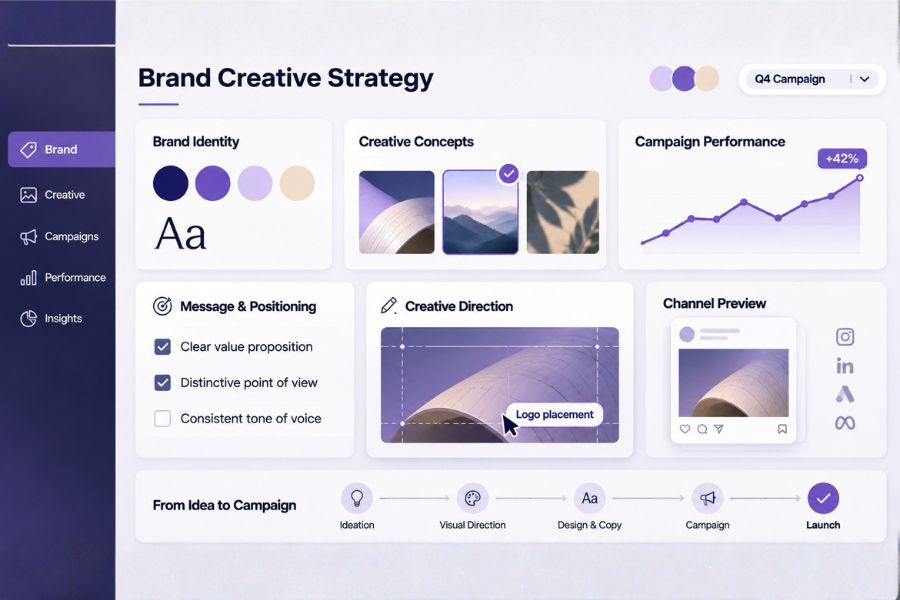
If the answer is no, your brand creative strategy might need more attention.
For companies investing in paid advertising, social media, and digital content, this matters. Every campaign creates an opportunity to strengthen the associations people have with your business.
When your creative looks interchangeable with everyone else’s, you risk spending money attracting attention that nobody connects to your brand.
Looking Professional Is No Longer Enough
Open Instagram or LinkedIn and examine the advertisements in your industry.
You’ll probably notice familiar patterns.
Similar layouts. Similar stock imagery. Similar messaging about quality, expertise, and customer satisfaction.
Everyone is trying to look professional.
The problem is that professionalism alone doesn’t make a business distinctive.
For high-ticket service providers, the challenge is especially important.
Potential customers may research several companies before deciding who deserves a conversation. If every brand communicates in the same way, remembering which company offered what becomes difficult.
Your creative needs to express something recognisable about your business.
That could come from your visual identity, tone of voice, messaging, photography, or a consistent approach to communicating your expertise.
The objective is to build familiarity that carries across campaigns and channels.
1. Your Creative Changes Personality Every Month
One month, your brand uses minimalist visuals and direct messaging.
The next month, everything becomes colourful, playful, and full of trending expressions.
Then a new campaign introduces another visual direction.
Individually, the designs might be excellent.
Together, they communicate very little consistency.
Experimentation is useful, but constant reinvention can make recognition harder.
A strong brand creative strategy establishes elements that remain familiar while giving your team room to develop new ideas.
Your logo, visual language, typography, recurring design elements, and tone of voice should support a recognisable identity.
This doesn’t mean every advertisement needs to look identical.
It means someone should be able to recognise your brand across different executions.
Research published in the International Journal of Advertising in 2026 examined distinctive brand assets across multiple industries and found meaningful differences in how effectively visual and other assets become associated with brands.
The practical lesson is that brand assets should be deliberately developed and used consistently, rather than selected purely because they look attractive.
2. You’re Following Trends Instead of Building Recognition
Trends can make content feel current.
A popular visual style, video format, or social media concept may create an opportunity to connect with an audience.
But following every trend comes with a cost.
Your brand can start looking like a collection of unrelated creative experiments.
Before adopting a trend, ask whether it fits your positioning and makes sense for the people you’re trying to reach.
A company offering high-value financial services has different communication requirements from a consumer entertainment brand.
That doesn’t mean premium businesses must communicate in a boring or overly formal way.
They can be bold, creative, and memorable.
But the creative choices should support the brand’s character and customer expectations.
At Onum, our approach to creative services starts with understanding what the business needs to communicate and who needs to hear it.
3. Your Message Could Belong to Any Competitor
Visual consistency is only part of the problem.
Your messaging also needs a recognisable point of view.
Consider how many businesses describe themselves as trusted partners offering innovative, tailored solutions.
Those statements may sound reassuring, but they rarely explain anything specific.
A stronger message identifies a genuine customer problem, communicates a clear perspective, or demonstrates relevant expertise.
For example, a marketing agency that believes clients deserve transparent reporting can build creative around accountability, business outcomes, and difficult conversations.
That’s more distinctive than another generic promise to help businesses grow.
The strongest creative ideas often emerge from the way a company actually operates.
What do your customers appreciate about working with you?
Which problems do you approach differently?
What do you believe businesses in your industry consistently get wrong?
Those answers can provide material for a recognisable brand voice.
4. Your Brand Disappears Inside Your Advertisements
An advertisement can attract attention without strengthening recognition.
Imagine someone watches an entertaining video, remembers the story, and shares it with a colleague.
A few hours later, they can’t remember which company created it.
The creative achieved attention, but the connection to the advertiser was weak.
Brand recognition requires more than placing a logo in the final second.
Relevant brand elements should feel integrated into the experience.
That might involve a consistent visual language, recurring messaging, distinctive imagery, or recognisable creative formats.
The appropriate approach depends on the medium and the audience.
Research discussed by WARC in 2026 highlights the role of distinctive brand assets in helping people associate advertising with the correct brand over time.
This is particularly relevant when businesses run campaigns across several platforms.
Your Meta Ads and other marketing activities should feel connected to the same business, even when their formats and objectives differ.
5. You’re Measuring Engagement but Ignoring Recognition
Likes, shares, views, and engagement rates can help you understand how people respond to creative content.
But they don’t automatically prove that your brand is becoming more memorable.
A highly entertaining post might generate attention from people who have little interest in your services.
Similarly, a less popular campaign might communicate your expertise to a smaller, more relevant audience.
Both outcomes require context.
Where practical, examine whether people recognise your brand, associate it with the right services, and understand what differentiates your offering.
Brand-lift research, customer surveys, qualitative feedback, and changes in relevant branded search behaviour can contribute useful signals.
None should be treated as perfect proof of causation.
For businesses with longer sales cycles, recognition may develop over repeated interactions.
That’s why creative effectiveness should be evaluated over an appropriate period rather than judged entirely on immediate engagement.
What Isn’t Worth Doing
Don’t redesign your brand identity every time engagement declines.
Don’t copy a competitor’s creative direction simply because their advertisements appear successful.
And don’t produce content solely to fill a publishing calendar.
A consistent stream of forgettable creative can consume significant time and budget without building a stronger brand.
You should also question whether every new campaign needs a completely different concept.
Sometimes developing a recognisable creative idea over time is more valuable than constantly starting again.
The right decision depends on what your audience recognises and how your campaigns perform.
How to Build a More Recognisable Creative Strategy
Start by examining your existing content.
Look at advertisements, social media posts, videos, presentations, and website visuals together.
Do they communicate a consistent identity?
Can someone recognise your business without relying entirely on its logo?
Then identify the brand elements and messages worth maintaining.
Develop creative guidelines that support consistency while leaving enough flexibility for different campaigns.
Most importantly, connect creative decisions to your commercial objectives.
A business trying to attract premium customers needs to communicate the expertise, credibility, and value those customers expect.
Your creative should help make that positioning easier to understand and remember.
FAQ
What is a brand creative strategy?
A brand creative strategy defines how a business communicates its identity, positioning, and messages through visual and written content across different marketing channels.
Why is brand consistency important in advertising?
Consistency helps audiences recognise a business across repeated interactions. Familiar visual elements and messages can strengthen associations between advertisements and the brand behind them.
Can creative content generate engagement without building brand awareness?
Yes. Content can attract views, shares, or reactions without creating a strong connection to the advertiser. Evaluating creative effectiveness requires looking beyond engagement alone.
How often should a business change its creative direction?
There is no universal schedule. Creative should evolve based on business objectives, audience feedback, and performance, while protecting the distinctive elements that make the brand recognisable.
Let’s Create Something People Actually Remember
If your business is investing in creative content but struggling to build a recognisable identity, we’d be interested in understanding the challenge. Let’s talk about your brand, your audience, and how your creative could communicate your value more clearly.