Your website features an impressive collection of completed projects.
Beautiful screenshots, recognisable client logos, and carefully presented visuals demonstrate the work your team has delivered.
But a potential customer has questions.
What problem did you solve? Why did the client choose your approach? What actually changed after the project?
If your portfolio doesn’t answer those questions, you’re leaving an important part of the sales conversation unfinished.
This is where B2B case study marketing becomes valuable.
For businesses selling high-ticket services, showing completed work is useful. Explaining the thinking, process, and results behind that work gives prospective customers something more substantial to evaluate.
And when buyers are comparing several providers, that evidence can influence which companies make their shortlist.
A Portfolio Shows the Work. A Case Study Explains the Value.
A portfolio and a case study serve different purposes.
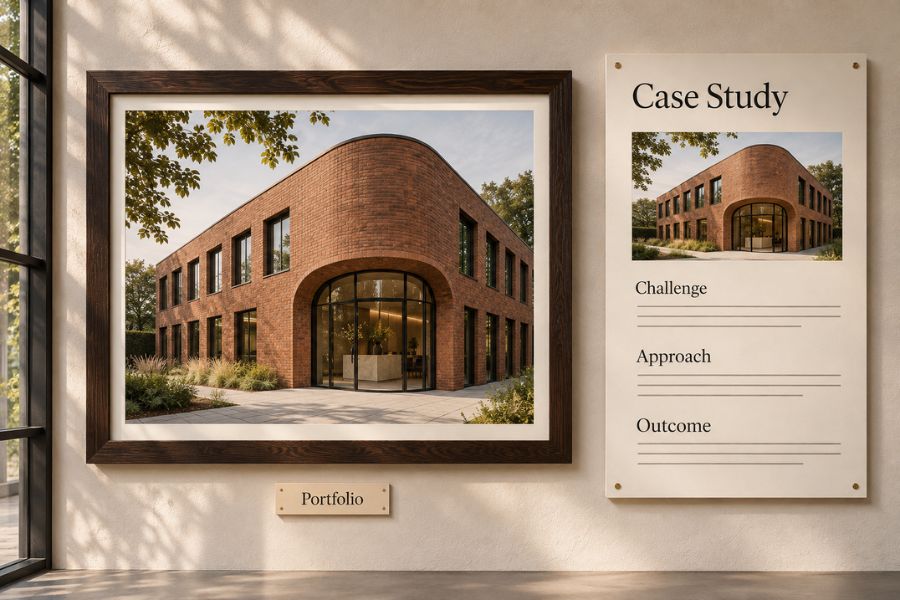
A portfolio provides a visual overview of your capabilities. It can demonstrate design quality, industry experience, and the variety of projects you’ve delivered.
A case study goes further.
It explains the client’s original challenge, the decisions made during the project, the solution delivered, and the outcome where reliable evidence exists.
Consider a company looking for a new website development partner.
A gallery of attractive websites might create interest.
But a case study explaining how a team approached complex requirements, organised a multilingual structure, and developed a more effective user experience provides much more context.
The buyer can begin imagining how a similar process might work for their own business.
That matters because high-value purchases involve uncertainty.
A well-written case study helps reduce that uncertainty through relevant evidence.
Why B2B Buyers Look for Proof Before Making Contact
Business buyers rarely evaluate suppliers based on appearance alone.
They research options, compare capabilities, and look for reassurance before committing to a conversation.
A 2025 EC-PR study on trust in B2B technology buying found that 48% of surveyed buyers used case studies to assess vendor credibility.
The finding doesn’t mean case studies guarantee sales.
It does reinforce the importance of providing evidence during the research process.
For businesses offering expensive or technically complex services, buyers need to understand whether a provider has relevant experience.
A detailed case study can help answer that question before the first meeting.
It can also support internal discussions when a potential customer needs approval from colleagues or company leadership.
1. Start With the Client’s Actual Problem
The strongest case studies begin with context.
What was the client trying to achieve?
What wasn’t working?
Which requirements made the project challenging?
Avoid opening with a long description of your agency or an exhaustive list of services.
The reader is more interested in whether you understand a problem similar to their own.
For example, a company might have needed a new website because its existing platform couldn’t support multilingual content or a growing range of services.
Those details explain the commercial and technical reasons behind the project.
They help the reader understand why the work was necessary.
And they establish a stronger foundation for explaining the solution.
2. Explain Your Decisions, Not Just Your Deliverables
A list of completed tasks is useful, but it doesn’t always demonstrate expertise.
Saying you designed a website, implemented SEO, and created new content explains what you delivered.
Explaining why those activities were prioritised demonstrates your thinking.
Perhaps the existing website lacked a clear service hierarchy.
Maybe the content didn’t address the questions potential customers were asking.
Or the technical structure made future expansion difficult.
Your case study should connect the decisions to the original problem.
At Onum, our website design and development projects involve understanding business requirements before selecting the appropriate structure and implementation.
That process is an important part of the value clients receive.
A case study gives us the opportunity to make it visible.
3. Show Results Without Exaggerating Them
Results are often the most compelling part of a case study.
They can also be the easiest part to misrepresent.
A business might report increased website traffic, stronger enquiry volumes, improved advertising efficiency, or a successful technical implementation.
Where reliable data exists, explain the outcome clearly.
Our iOwn project is an example where the published case study reports organic traffic reaching ten times the level of the previous website.
A claim like this should always be supported by the underlying data and an appropriate comparison period.
But not every project needs an impressive percentage.
Sometimes the meaningful outcome is a clearer website structure, a completed platform migration, or a process that supports future growth.
Describe what can genuinely be demonstrated.
If the results are still developing, say so.
Credibility is more valuable than an exaggerated success story.
4. Make Your Case Studies Relevant to Different Buyers
A business evaluating an agency may have several priorities.
A marketing director wants to understand strategic thinking and performance.
A technical manager may focus on implementation quality.
A business owner might care about the commercial objectives and the working relationship.
One case study can address several perspectives without becoming unnecessarily long.
Explain the challenge in business terms.
Describe the relevant technical and strategic decisions.
Then communicate the outcome in language that decision-makers can understand.
For example, a project involving SEO & GEO should explain how the content or technical strategy supported the client’s search objectives.
A website project should show how the structure and experience were designed around the client’s requirements.
The goal is to make your expertise easier to evaluate.
5. Your Case Studies Should Support the Sales Process
Publishing a case study isn’t the final step.
It should be easy for potential customers to discover relevant examples while researching your services.
Link related projects from service pages.
Use appropriate examples in proposals and follow-up conversations.
Give your sales team material they can share when prospects raise specific concerns.
If a potential customer asks whether you’ve worked with a similar business, a relevant case study can provide a practical answer.
Your portfolio should function as a useful resource throughout the buying journey.
That requires organising projects around meaningful information, not simply publishing them in chronological order.
What Isn’t Worth Doing
Don’t turn every project into a dramatic success story.
Don’t invent performance improvements, publish confidential information without permission, or use customer testimonials that haven’t been approved.
You should also avoid creating case studies filled with vague phrases such as “exceptional results” and “complete transformation” without explaining what those statements mean.
And don’t assume that a gallery of screenshots provides enough information for serious buyers.
If the work was valuable, explain why.
If the outcome cannot be quantified, focus on the verified deliverables and the problem they addressed.
Truthful examples build stronger foundations for trust.
Build a Portfolio That Helps Customers Choose You
Start by reviewing your strongest completed projects.
Choose examples that reflect the services you want to sell and the types of customers you want to attract.
For each project, document the original challenge, the approach, the work delivered, and the outcomes you can verify.
Keep the writing clear and specific.
Then connect those case studies with relevant service pages and sales materials.
A good portfolio demonstrates capability.
A strong collection of case studies helps potential customers understand how that capability applies to their own business.
For companies competing for high-value projects, that difference deserves attention.
FAQ
What is B2B case study marketing?
B2B case study marketing uses documented client projects to demonstrate a company’s expertise, approach, and relevant outcomes. It helps potential customers evaluate whether a provider is suitable for their needs.
What’s the difference between a portfolio and a case study?
A portfolio primarily showcases completed work. A case study provides additional context by explaining the client’s problem, the solution delivered, and the results where evidence is available.
Do case studies help generate B2B leads?
They can support lead generation by building credibility and helping prospective customers evaluate a provider. Their impact depends on relevance, quality, distribution, and the wider buying journey.
What should a good B2B case study include?
It should explain the client’s challenge, the project’s objectives, the decisions made, the work delivered, and any outcomes that can be accurately supported.
Let’s Give Your Next Project a Stronger Story
If your business delivers valuable work but your website isn’t communicating that expertise clearly, we’d be happy to explore the opportunity. Let’s talk about your projects, your positioning, and how your digital presence can help potential customers understand what makes your business worth choosing.