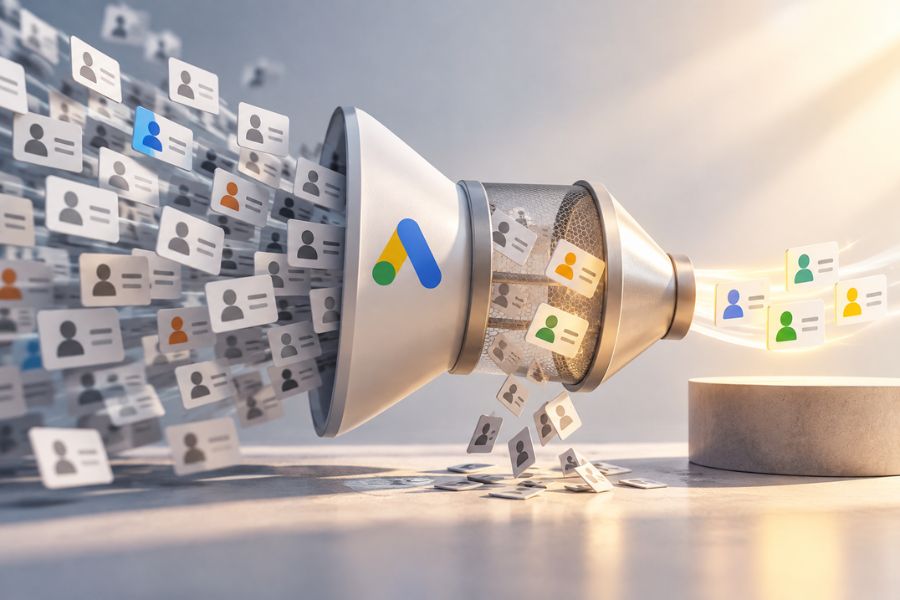
A potential customer opens ChatGPT and asks for recommendations in your industry.
Your competitors appear in the response. Some are mentioned by name, while others are supported by links to their websites.
Your business is nowhere to be found.
It’s frustrating, particularly if you’ve spent years investing in SEO, building your reputation, and developing a credible offering.
But AI search brand visibility is becoming another consideration for businesses that depend on being discovered during the research process.
For high-ticket services, this matters because customers often compare providers before making contact.
If AI-powered search becomes part of that research, you want your business to be represented accurately and considered when relevant.
So why might your competitors appear while your brand doesn’t?
AI Search Doesn’t Evaluate Businesses Like a Traditional Directory
When someone asks ChatGPT, Perplexity, or Google AI Mode to recommend businesses, the response isn’t necessarily generated from a fixed list of companies.
Depending on the platform and question, the system may retrieve information from websites, compare sources, and generate an answer based on the available context.
The wording of the question matters.
Someone searching for “best digital marketing agencies” may receive a different response from someone asking for “an agency specialising in SEO and paid advertising for European B2B companies”.
The second query provides more specific requirements.
This is especially relevant for businesses offering specialised, high-value services.
You might be a credible provider without being a relevant recommendation for every broad industry question.
Before worrying about whether your brand appears, consider whether you’re testing the questions your actual customers would ask.
1. Your Website Isn’t Specific Enough About What You Do
Many businesses describe themselves using language that could apply to almost any competitor.
They offer innovative solutions, exceptional service, and a personalised approach.
But what do they actually deliver?
AI-powered search systems need accessible information to identify relevant businesses and supporting sources.
If your website doesn’t clearly explain your expertise, target audience, services, and capabilities, it may provide less useful information for relevant research queries.
Take a company offering enterprise software implementation.
Its website should identify the technologies it works with, the problems it solves, the businesses it serves, and the services included in its engagements.
These details help potential customers understand whether the company is a suitable provider.
They also make the website more useful as a source of information.
A well-defined SEO & GEO strategy should strengthen this clarity across service pages, supporting articles, and relevant case studies.
2. Your Competitors Have Stronger Supporting Evidence
Imagine two businesses offering similar professional services.
One has a short homepage, a few general service descriptions, and limited information about completed work.
The other publishes detailed project examples, explains its methodology, answers technical questions, and maintains credible references across relevant industry websites.
The second business gives prospective customers more information to evaluate.
It may also provide AI-powered search systems with more useful source material.
That doesn’t guarantee it will appear in an AI-generated response.
But demonstrating expertise is a sensible investment regardless of the discovery channel.
Case studies are particularly valuable when they describe real challenges and the work delivered.
For example, our Futora project demonstrates how search-focused content can support the discoverability of a specialised business.
We’ve also observed a multilingual client appearing in relevant AI-generated answers.
These observations are encouraging, but an AI mention alone doesn’t establish how many qualified leads or customers were generated.
3. Your Brand Has Limited Visibility Beyond Its Own Website
Your website is an important source of information about your business.
But it’s also a source you control.
Potential customers often look beyond a company’s own claims when evaluating whether to trust it.
They may examine independent reviews, relevant publications, professional profiles, partnerships, and other credible references.
Those sources can also contribute to the information available to AI-powered research systems.
This is why genuine brand visibility beyond your website deserves attention.
Look for opportunities to contribute expertise to relevant industry publications, participate in professional communities, and build relationships with credible organisations.
Keep your company information accurate and consistent across appropriate platforms.
However, avoid assuming that every external mention will influence AI recommendations.
Relevance, credibility, and context matter more than accumulating mentions for their own sake.
4. Your Website Might Be Difficult for AI Search to Access
Sometimes visibility problems have a technical explanation.
A website may block relevant crawlers, contain indexing restrictions, or make important content difficult to access.
For ChatGPT Search, OpenAI identifies OAI-SearchBot as the crawler used to help surface websites in search results.
For Google’s AI search experiences, existing search fundamentals remain important, including indexing, accessible content, and internal linking.
Google also provides controls for inclusion in its generative AI search features.
Before pursuing complicated optimisation techniques, check the basics.
Can relevant systems access your important pages? Are those pages indexable where required? Does the website communicate its services through accessible text?
Structured data can help search engines understand supported information, but there is no special schema that guarantees inclusion in AI answers.
Technical accessibility creates an opportunity to be considered. It doesn’t guarantee a recommendation.
5. You’re Measuring Visibility Through Random Prompts
One of the easiest mistakes is opening ChatGPT, asking a question, and treating the response as a definitive ranking report.
AI-generated responses can vary according to the wording, context, platform, and information retrieved.
A business appearing in one response doesn’t necessarily mean it will appear consistently.
A more useful approach is to develop a set of relevant research questions.
Include questions about your service category, customer problems, industry requirements, and comparisons between potential providers.
Test those questions periodically using a consistent process.
Record whether your brand appears, how accurately it is described, which competitors are mentioned, and what sources support the answers.
Where available, combine these observations with AI referral traffic, Search Console insights, and customer enquiry data.
Google introduced additional reporting for generative AI search visibility in 2026, creating opportunities for more direct measurement within its own ecosystem.
Still, no single report provides a complete picture of visibility across every AI platform.
What Isn’t Worth Doing
Don’t publish hundreds of generic AI-generated articles hoping to increase your mentions.
Don’t purchase irrelevant backlinks or artificial brand references.
Don’t pay for promises of guaranteed ChatGPT recommendations.
And don’t abandon traditional SEO because your competitors appeared in a few AI responses.
Google’s own guidance continues to emphasise useful, original content, technical clarity, and established SEO practices rather than speculative GEO tricks.
Your investment should strengthen the information and credibility behind your business.
If an optimisation activity doesn’t improve the experience of a potential customer or address a genuine discoverability issue, question its value.
Where Should You Start?
Begin by identifying the questions relevant buyers ask before choosing a provider.
Then compare how your business and competitors are represented across AI search platforms.
Look for missing information, inaccurate descriptions, and differences in supporting evidence.
Review your most commercially important service pages.
Are they specific, useful, and supported by credible examples?
Check technical accessibility and your external business profiles.
Finally, establish a repeatable measurement process.
AI search visibility is worth investigating, but it should remain connected to broader marketing objectives.
Being mentioned is useful only insofar as it contributes to relevant discovery, stronger consideration, or meaningful business opportunities.
FAQ
Why does ChatGPT recommend my competitors instead of my business?
Possible reasons include differences in available source information, relevance to the question, technical accessibility, and the context of the response. There is no single guaranteed factor that determines recommendations.
How can I improve AI search brand visibility?
Start with clear service information, credible supporting evidence, accessible website content, relevant external references, and consistent monitoring of the questions your customers ask.
Do backlinks help with AI search visibility?
Relevant, credible references can support your wider online reputation and search visibility. However, there is no reliable formula linking a specific number of backlinks to AI recommendations.
Can I track whether my brand appears in AI search?
Yes, through structured prompt monitoring, available platform reporting, referral analytics, and customer feedback. Measurements have limitations, so results should be interpreted carefully.
Let’s Find Out Where Your Brand Stands
If your competitors are appearing in AI-powered search results and you’re unsure how your business compares, we’d be happy to investigate the opportunity. Let’s talk about your current visibility, your competitive landscape, and what deserves attention in your search strategy.