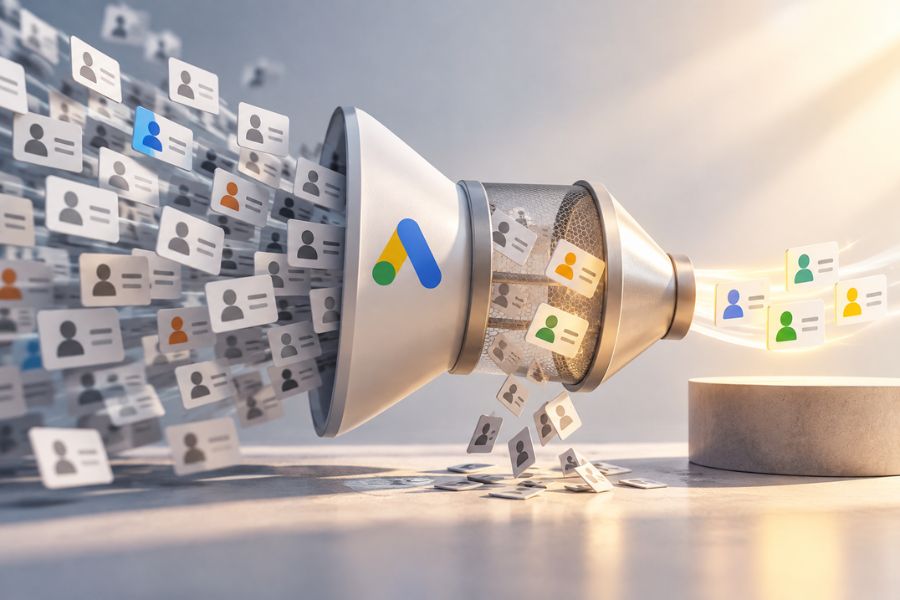
Your website traffic is increasing. Google Analytics shows more visitors, your SEO rankings are improving, and your marketing reports look encouraging. Yet your inbox tells a different story. You’re getting website traffic but no leads, or worse, enquiries from people who were never going to become customers.
For a business selling high-value services, this is a serious problem.
More visitors should create more opportunities, but only when the right people arrive, understand your offering, and have a reason to contact you.
If that isn’t happening, there’s usually a disconnect somewhere between your marketing strategy and your customer’s decision-making process.
Not All Website Traffic Has Commercial Value
One of the most common mistakes businesses make is treating every website visit as equally valuable.
Imagine you run a consulting firm offering services to established companies.
Your website attracts thousands of visitors through an article explaining a basic industry concept. That’s useful for visibility, but many of those visitors might be students, job seekers, or people looking for free information.
Now imagine another page attracts considerably fewer visitors, but those visitors are business owners actively comparing consulting providers.
Which audience is more valuable?
The answer depends on your objectives, but for most high-ticket service providers, the second group has stronger commercial potential.
This is why a successful SEO & GEO strategy needs to consider search intent, audience relevance, and the quality of opportunities generated.
Traffic growth without context can give you a misleading picture of performance.
1. You’re Attracting People Who Aren’t Ready to Buy
Search intent explains what someone is trying to accomplish when they enter a query.
Some searches are informational. Others involve comparing solutions, evaluating providers, or preparing to make a purchase.
All can play a role in your marketing strategy.
The problem starts when most of your content attracts people seeking general information, while very little supports visitors who are considering your services.
What to Look For
Open Google Search Console and examine the queries bringing visitors to your website.
Are they researching broad topics, or are they searching for the types of services your business actually sells?
Then check which landing pages generate enquiries.
You may discover that an article attracting significant traffic contributes very little to your sales pipeline, while a specialised service page generates more meaningful conversations.
That doesn’t automatically make the informational article worthless. It may introduce your brand to future customers.
But your content strategy needs to support multiple stages of the buying journey, including the stage where people evaluate whether to work with you.
2. Your Website Doesn’t Explain Why Someone Should Choose You
Many business websites describe their services without clearly explaining their value.
Statements such as “tailored solutions”, “industry-leading expertise”, and “innovative approaches” appear everywhere.
They rarely give buyers enough information to make a decision.
A potential customer considering a substantial investment wants specifics.
Who do you work with? What problems do you solve? What does your process involve? Have you delivered similar projects?
Your website should answer these questions without forcing the visitor to schedule a meeting just to understand the basics.
Relevant case studies, clear service descriptions, and transparent explanations of your working process can help.
For businesses selling high-ticket services, trust is built through evidence and clarity.
If your website looks impressive but doesn’t communicate those things, the design alone won’t save the conversion rate.
3. Your Calls to Action Don’t Match the Buyer’s Intent
Not every visitor is ready to request a proposal.
Someone researching a complex service for the first time may want to understand your approach before committing to a conversation.
Another visitor might already have a defined project and be ready to speak with your team.
If both see the same aggressive “Get a Quote Now” message everywhere, you’re ignoring the difference between them.
Your calls to action should reflect the page’s purpose.
A detailed educational article can naturally guide readers towards a relevant service page.
A service page should explain what happens when someone makes an enquiry.
A case study can invite visitors to discuss a similar challenge.
The objective is to make the next step relevant and easy to understand.
That principle should influence both your website’s content and its design.
Our approach to website design and development considers how visitors move from discovering a business to evaluating whether it’s the right partner.
4. Your Website Creates Unnecessary Friction
Sometimes the problem has very little to do with your traffic.
A visitor might be genuinely interested, but the website makes contacting you unnecessarily difficult.
Perhaps the contact form asks for too much information. Maybe the mobile experience is frustrating. The page could load slowly, or the contact button might be difficult to find.
There may even be a technical issue preventing form submissions from reaching your team.
Before investing in more traffic, test the actual enquiry process.
Complete your own forms on desktop and mobile. Check whether submissions are recorded and delivered correctly. Review the experience from the perspective of someone who has never used your website.
Tools such as Microsoft Clarity can provide additional behavioural insights, including where users encounter friction.
But avoid assuming every visitor who leaves a page is experiencing a problem. Some people simply found the information they needed.
Look for consistent patterns before making major changes.
5. You’re Measuring Conversions Without Measuring Lead Quality
A submitted contact form might count as a conversion in your analytics platform.
That doesn’t mean it represents a genuine business opportunity.
If your website generates enquiries from unsuitable companies, unrealistic budgets, or people seeking unrelated services, your conversion numbers can look healthy while your sales team struggles.
For high-ticket businesses, lead quality matters.
This means connecting website performance with information from your CRM or sales process.
A useful measurement framework should distinguish between enquiries received, qualified opportunities, meetings booked, and customers acquired.
These stages reveal much more than a single conversion rate.
They also help identify whether the problem originates in acquisition, website messaging, or the sales process itself.
What Isn’t Worth Doing
If your website gets traffic but no qualified leads, increasing your advertising budget shouldn’t be your automatic response.
Neither should publishing dozens of generic blog posts, redesigning every page, or adding more contact buttons without understanding the problem.
These activities can consume resources without addressing the underlying issue.
Start by identifying where the disconnect occurs.
If the wrong audience is visiting, investigate targeting and search intent.
If relevant visitors aren’t enquiring, examine your offer, messaging, credibility, and user experience.
If enquiries arrive but rarely become customers, look at qualification and sales follow-up.
Different problems require different solutions.
How to Turn Traffic Into Better Opportunities
You don’t need to rebuild your entire marketing strategy overnight.
Start with your commercially important pages.
Identify the services that matter most to your business and examine how those pages perform.
Compare their traffic with enquiries and, where possible, qualified sales opportunities.
Then review whether the content answers the questions a serious buyer would ask.
Look at the journeys visitors take before contacting you. Strengthen relevant internal links, remove unnecessary friction, and make the next step clear.
Most importantly, involve your sales team.
The questions prospects ask during calls can reveal content gaps that analytics tools will never identify.
A website should evolve based on what customers actually need to know.
FAQ
Why is my website getting traffic but no leads?
Common reasons include attracting the wrong audience, unclear service messaging, weak calls to action, technical problems, and a website experience that doesn’t support the buyer’s decision-making process.
Does more website traffic mean more sales?
Not necessarily. Traffic volume matters less when visitors aren’t relevant to your offering. Qualified traffic and the ability to convert interested visitors into meaningful conversations are more useful business indicators.
How can I improve website lead generation?
Start by reviewing search intent, important landing pages, service messaging, contact forms, and conversion tracking. Use sales feedback to understand whether the enquiries you’re generating match your ideal customer profile.
Should I invest in SEO or website conversion optimisation first?
It depends on the problem. If you’re attracting relevant visitors but receiving few enquiries, conversion improvements may deserve priority. If the website lacks visibility among potential customers, SEO may need more attention. Many businesses benefit from coordinating both.
Let’s Talk About What’s Happening After the Click
If your website is attracting visitors but not generating the opportunities your business needs, we’d be happy to examine where things might be going wrong. Let’s talk about your traffic, your customers, and what could make your website work harder for your business.